
Quality Checks During Column & Beam Work: What Homeowners Should Know
Columns and beams are the skeleton of your home. In residential construction in Bangalore, these structural elements carry all the load — your roof, upper floors, walls, and more. If they are weak or poorly done, the entire building suffers. Here are the quality checks every homeowner should insist on during column & beam work to ensure a strong, safe, and long-lasting structure.
1. Correct Concrete Grade
One of the first things to check is whether the right concrete grade is used for your columns and beams. IS 456:2000 (Indian Standard) mandates M20 grade or higher for reinforced concrete (RCC) works. Using a weaker grade than what is specified in your plan can lead to cracks, deflections, or even structural failure under heavy loads. So verify with your contractor or structural engineer that the mix (cement : sand : aggregate) is as per design.
2. Steel Reinforcement: Quality, Placement & Cover
The steel (TMT bars) used inside columns and beams must be of good quality. Commonly used are Fe500 grades or equivalent. Confirm the brand and the quality of steel. Also ensure the steel bars are placed exactly as per your structural drawings — proper spacing, correct number of bars, lap lengths where two bars overlap, and properly tied with binding wire.
Another thing: concrete cover. This means the distance between the steel bars and the outer surface of concrete. Cover protects steel from moisture, corrosion, and fire. IS codes specify minimum clear cover, depending on exposure conditions. If cover is too small, steel may corrode; too large, it may affect strength.
3. Formwork / Shuttering Quality
Formwork or shuttering is the mould into which concrete is poured to form columns and beams. Poor shuttering leads to uneven surfaces, leaks of cement slurry (honeycombing), or misalignment. Key things to check:
- Clean formwork before pouring (no debris or dirt inside).
- Joints between shuttering panels should be tight to prevent leaks.
- Proper propping and bracing to hold formwork rigid during pouring — wet concrete is heavy and exerts pressure.
4. Alignment, Plumb & Level
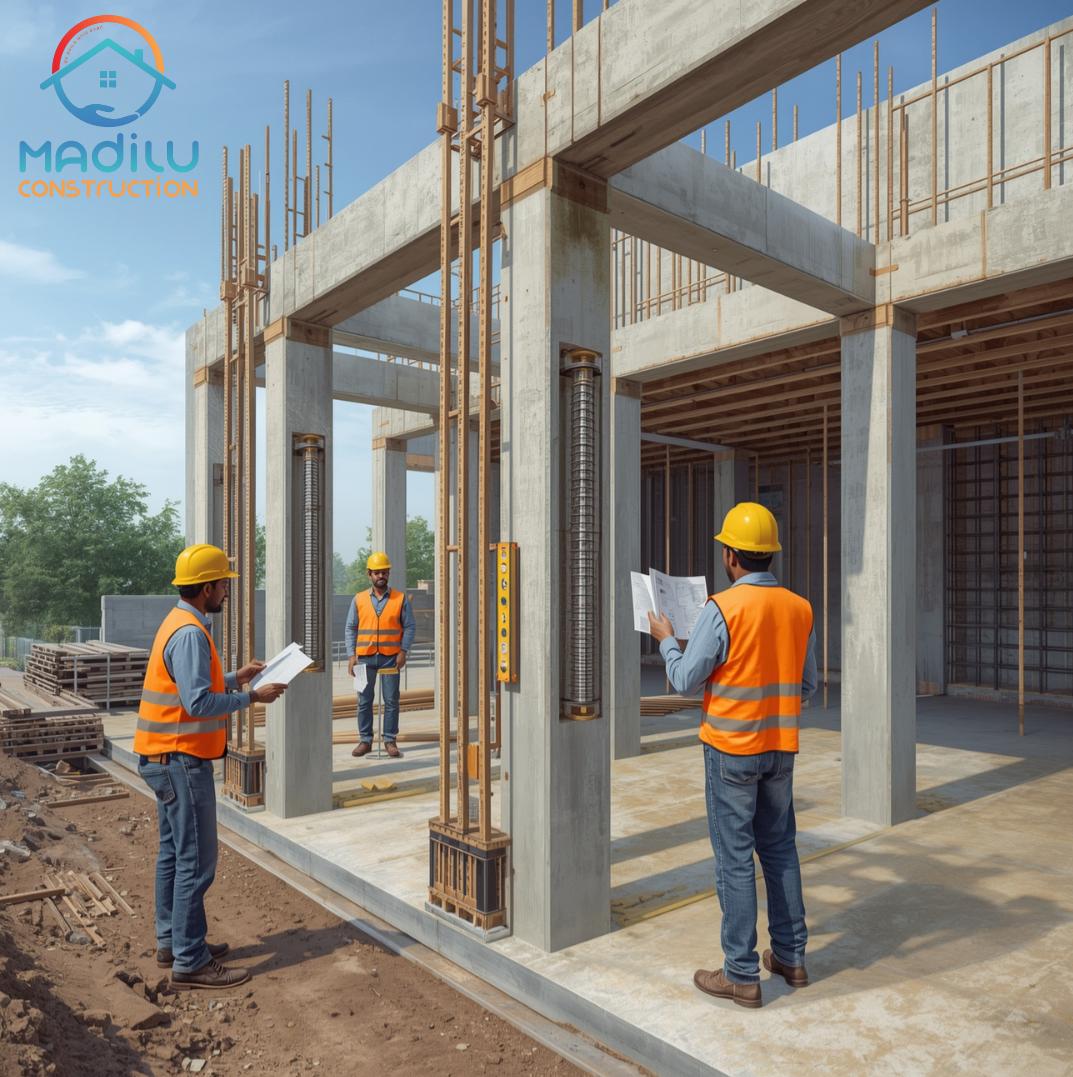
Once reinforcement and formwork are in place, check alignment of columns (vertical straightness) and level of beams. Use plumb bobs, spirit levels, or laser levels to ensure accuracy. Even small deviations can affect doors, windows, and finishes later.
Also verify column and beam dimensions match the design. Any deviation can impact strength and load-bearing capacity.
5. Joint & Connection Checks (Beam-Column Junctions)
Connections between beams and columns are among the most critical zones in your home’s structure. Poor detailing here can cause weak joints and cracks. Make sure:
- Beam reinforcement extends correctly into the column (development length) for proper anchorage.
- Stirrups (ties) around main bars are as per design.
- Concreting in these junctions is done with proper compaction to avoid air pockets.
6. Concrete Mixing, Slump & Compaction
- Check the mix ratios — too much water makes concrete weak.
- Perform a slump test to ensure correct workability.
- During pouring, ensure vibration/compaction to remove air pockets and avoid honeycombing.
7. Curing & Formwork Removal Timing
After concreting, curing keeps concrete moist for proper strength development. In Bangalore’s dry climate, curing is critical for at least 7–14 days. Don’t remove shuttering too early — wait until the structure gains adequate strength to avoid cracks or deformation.
8. Material Quality Certification & Supplier Traceability
- Ask for steel mill test certificates (for TMT bars).
- Check cement brand, batch, and expiry date.
- Ensure aggregates are clean and water used for mixing is potable.
Using substandard materials can lead to costly repairs later — always insist on certified quality.
9. Supervision & Documentation
- Ensure a structural engineer or site engineer inspects at key stages.
- Document deviations and corrective actions with photographs.
- Request “as-built” drawings if changes occur during construction.
10. Local Climate & Soil Considerations in Bangalore
Bangalore’s climate and soil vary — heavy rains, dry spells, and clayey soils can impact your structure. Ensure proper waterproofing, curing, and that the foundation design suits the soil bearing capacity.
How Madilu Construction Ensures Quality
- Adherence to Standards & Codes: We follow IS 456, IS 13920, IS 1786 for all RCC design and execution.
- Material Traceability: Every batch of steel, cement, and aggregate comes with test certificates from trusted suppliers.
- Precision in Execution: Our site engineers check reinforcement, beam-column junctions, and alignment before pouring.
- Rigorous Supervision & Documentation: Every stage — from reinforcement to curing — is monitored and documented.
- Caring Curing & Prop Removal: Props are removed only when concrete gains sufficient strength.
- Transparent Communication: We keep homeowners informed of every quality check — building trust through clarity.
By choosing Madilu Construction for your home in Bangalore, you gain a partner committed to building structurally sound, aesthetically pleasing, and long-lasting homes. Because for us, quality is non-negotiable.
Ready to build a strong, lasting home in Bangalore?
Talk to Madilu Construction about your dream project today.